Our Point of View: The Reality of AI in Equestrian Business
This post was not written by AI.
AI is everywhere.
Some of what we see is genuinely exciting.
Some of it… not all of it.
We are not against new ideas; in fact, we area all about new ideas; that is what helps us continue to thrive. The reason why we maintain this view is because we have spent enough time in this space to understand the difference between what the market actually needs and what companies think it needs; both inside and outside of equestrian sports.
We are approached almost daily with entrepreneurs looking for support. They all have ideas, many backed by the same statistics:
- The U.S. equestrian industry contributes $177 billion annually.
- Equestrian sports create 2.2 million jobs.
- Equestrian has $74 billion in direct economic impact.
- There are 9 million+ horses within the US.
We know the numbers by heart because they are in almost every deck, every business proposition and every presentation we see.
The question we would like to challenge start-ups and entrepreneurs to ask themselves is as follows:
“Do these stats somehow mean a product will succeed, even if no one actually needs said product?
When we add AI to the equation, it would be easy to think there is lots of potential. The thing is, there are hundreds of products right now waving the AI flag thinking this alone determines success.
It does not. AI is not the variable that decides whether a product sells. Statistics are also an irrelevant variable in whether or not your new product/service will sell or whether or not it is investible.
Investable ideas do one thing well: they answer a question that an industry is already asking. The addition of AI to any venture needs to contribute to solving an existing problem.
THE CHALLENGE
Most mediocre AI is invisible to the end user. Unless you have the ability to audit the underlying code, evaluate model architecture, and validate outputs against real-world data, you have no reliable way of knowing whether the system is sound. Maybe it is simply producing confident, but flawed, results.
We say that from experience. Our team works directly in AI within complex animal health systems. We understand what it actually takes to build models that are functional, valuable, usable, and monetizable.
THE FACTS
It is also worth stating something that gets lost in the noise;
AI is not new.
From a definitional standpoint, Google has been AI since day one. It has always used algorithms to process data, recognize patterns, and make decisions. The concept has not changed.
The only thing that has changed is the way AI is packaged.
Here is what AI has the potential to do:
- Process patterns
- Make predictions
- Optimizes based on data
Here is what AI cannot do:
- Fix a bad product
- Turn a bad idea into a good one
- Replace domain expertise
- Create value where none exists
- Fool educated audiences into believing something is real
If the foundation is flawed, AI will simply help you get to the wrong destination faster.
IT IS TIME FOR AN AI RESET
When it comes to AI in our sport or anywhere else, we would like to reset the conversation.
Just because something uses AI does not mean it is a good idea.
And it definitely does not mean it is intelligent.
Somewhere along the way, “AI-powered” became shorthand for “better.”
It is not; at least not always.
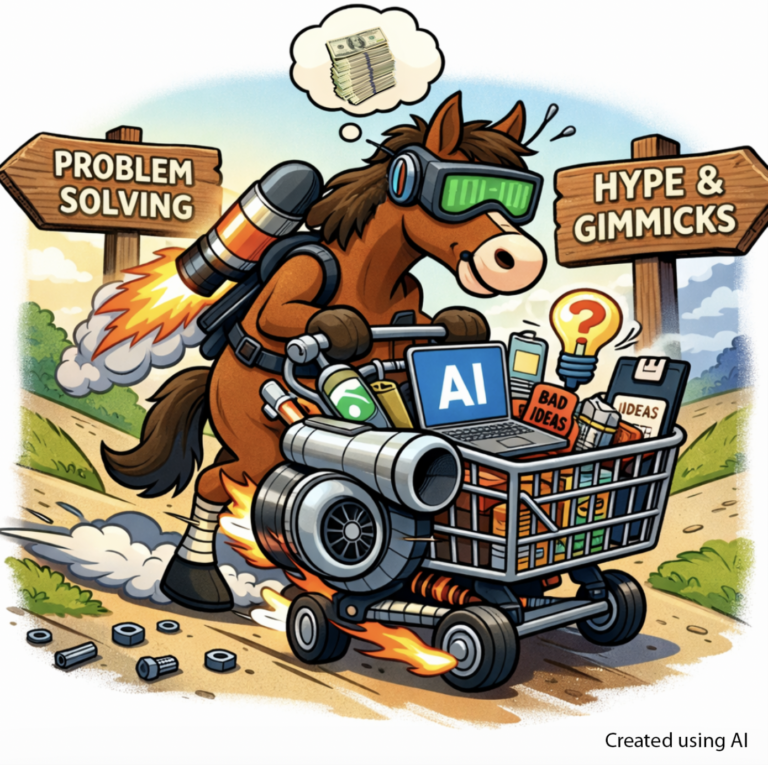
Putting AI into a product without solving a real problem is like putting a turbocharger on a shopping cart.
It sounds impressive.
Does it make it useful? No.
WHY MANY AI PRODUCTS/SERVICES MISS
- Founders start with the technology, not the problem. The question becomes, “Where can we use AI?” instead of “What problem actually needs to be solved?”
- They lack real data and bad data does not become good just because it runs through a model.
- They ignore context. AI can recognize patterns, but it cannot replace experience, judgment, or expertise. The team behind it still matters.
- They confuse automation with intelligence. Faster is not smarter and automated is not always better.
- People assume that AI can function independently of human intelligence. AI is not autonomous (contrary to the scare tactics we hear); human participation is required.
WHERE DOES AI ACTUALLY DELIVER?
When applied properly, AI is powerful.
- It reduces uncertainty by identifying patterns that are not visible to the human eye.
- It improves decision-making by turning data into something actionable.
- It enhances consistency in environments where variability creates risk.
- Most importantly, it works alongside expertise; it does not replace it.
THE BOTTOM LINE
AI is not a product; it is a tool.
Your product or service still needs to solve a real problem, deliver measurable value and perform reliably in the real world.
In the end, the winners will not be the ones who use AI the most. They will be the ones who use it to solve something that actually matters.
Everything else is marketing.
About SP Rhodes Equestrian Identity
SP Rhodes is a North American design and branding firm specializing in equestrian identity systems, custom equestrian products, and digital experiences. With studios in Wellington, Florida and North of the border in Ontario, Canada. SP Rhodes partners with leading equestrian venues and brands to create high-impact, design-driven solutions that shape how riders experience our sport.